Nature Methods: Getting over ANOVA
‘Getting over ANOVA’ is the title of our paper on multi-group data, out today in Nature Methods. 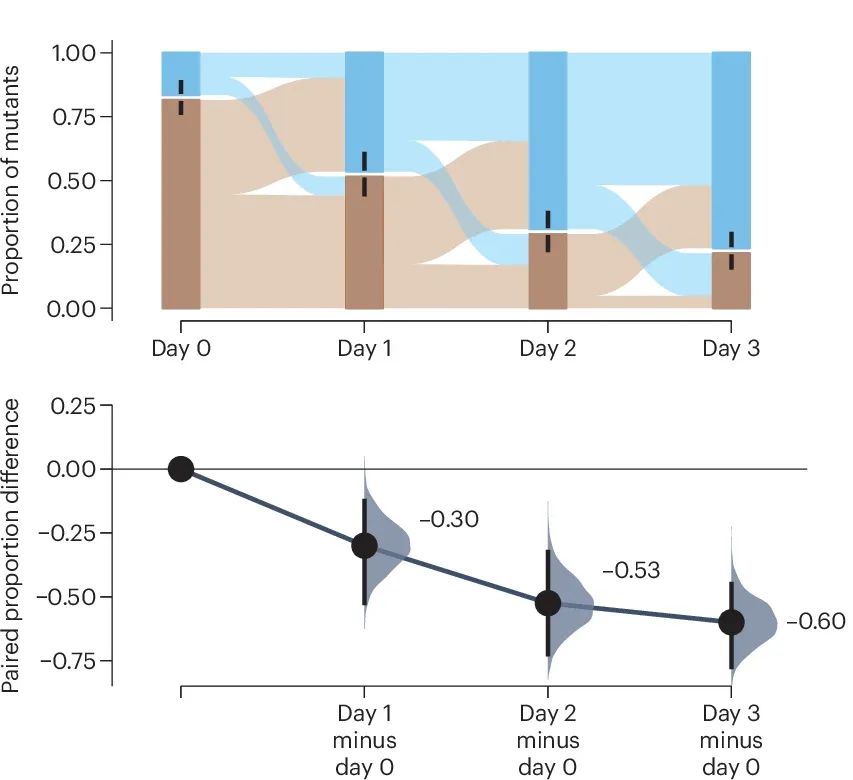
The break-up is overdue. ANOVA asks whether all the groups are the same—a question nobody wants answered—and then sends you off to a pile of post-hoc tests nobody wants either. So what replaces it? We need methods that answer what we actually want to know: which groups differ, in which direction, and by how much. And they should not just report it, but also show it.
The new paper describes a software package, DABEST 2.0, that brings estimation graphics to multi-group data: repeated measures, two-factor interactions via delta-delta effects, binary outcomes, and internal replicates via mini-meta. Some graphics can directly replace an ANOVA method. Each graphic shows the raw data, the effect size, and the uncertainty.
Building software to visualize multi-group effect sizes has been a collaborative effort by the DABEST team, and I’m proud of what we built. DABEST is open source and available in Python, R, and through a web app. Data analysis should be easy to practice, and give you direct answers to the questions your experiments were designed to ask.
Shout out to the team: Zinan Lu, Jonathan Anns, Yishan Mai, ROU ZHANG, CFA, Kahseng Lian, Nicole Lee, Shan Hashir, Zhuoyu Wang, Yixuan Li, A. Rosa Castillo, Joses Ho, Hyungwon Choi, Sangyu Xu and Adam Claridge-Chang.
Also posted on LinkedIn.
